The Troubles
Say NothingThe Troubles was a prolonged conflict in Northern Ireland in which political division, communal fear, and armed violence reshaped everyday life. Its course ran from civil-rights marches and the collapse of public order into a rising campaign of shootings and bombings; later, prison protest and electoral politics became part of the struggle. The Good Friday Agreement brought a power-sharing settlement, but not a shared account of the past: the book presents the conflict’s unresolved disappearances, disputed responsibility, and still-divided neighborhoods as part of its continuing legacy.
Background and outbreak
The conflict’s divisions were rooted in partition and in opposing fears of political subordination. Protestants formed a majority in Northern Ireland but a minority on the island as a whole, and feared being absorbed into a Catholic Ireland. Catholics, the majority on the island but a minority in Northern Ireland, experienced systemic discrimination in the six counties. Against this background, students assembled outside City Hall in Donegall Square on 1 January 1969 to begin a planned march from Belfast to Derry, about seventy miles away. Their purpose was to protest discrimination through peaceful action. Some were prepared for a violent response and thought the spectacle of a crackdown might help expose injustice; they also imagined that the political division might be recast as a generational contest between young people and defenders of the old order.
The summer’s violence in Derry gave those hopes a harsher setting. The annual Apprentice Boys march commemorated the closing of the city gates against Catholic forces in 1688. At its conclusion, marchers traditionally threw pennies from the walls toward homes in the Catholic Bogside. That year the provocation was met with resistance, and riots spread through Derry in what became known as the Battle of the Bogside. The McConville family, among those displaced from their East Belfast home that summer, experienced the conflict not as an abstract constitutional dispute but as a force that could uproot a household.
The British Army arrived in response to the Battle of the Bogside and the riots. Catholics initially welcomed the troops, regarding them as more neutral than the Royal Ulster Constabulary and the B-Specials, whom they considered sectarian authorities. In West Belfast, mothers brought tea to soldiers at sandbagged posts. That welcome did not last as a simple story of protection: armed confrontations widened, and the army became one of the forces against which Catholic gunmen fought.
Militarization and rising violence
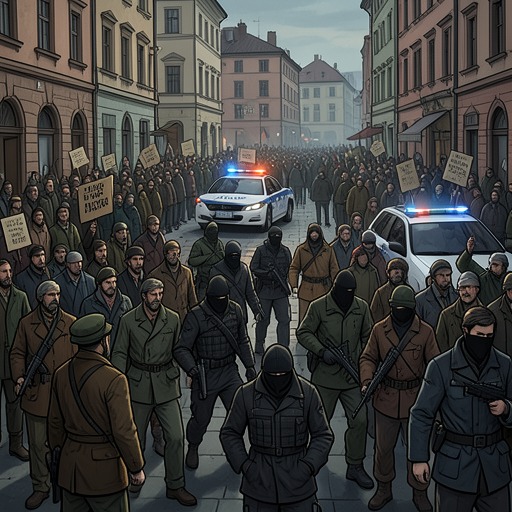
During the early clashes, Catholics armed themselves and shot at loyalist opponents, police, and eventually British troops. Snipers fired from rooftops at night; soldiers and police answered with heavier weapons, including M1 carbines and Sterling sub-machine guns. The B-Specials shot out street lights in an effort to make snipers harder to see, while British troops patrolled darkened streets in Land Rovers with their headlights off. These details convey how conflict entered the fabric of the city: darkness, armed patrols, and the threat of sudden violence became features of ordinary streets.
The death toll rose sharply. Nineteen people were killed in 1969 and twenty-nine in 1970; nearly two hundred died in 1971, and nearly five hundred in 1972, the conflict’s bloodiest year. The British military presence expanded at the same time: from 2,700 troops in the summer of 1969 to more than 30,000 by the summer of 1972. Many were young and inexperienced, deployed for four-month tours. The book sets their uncertainty about what counted as success against the intensifying violence: they had been sent to quell unrest, yet the bloodshed continued to increase, and the political status of the place they were sent to police remained a source of uncertainty.
The riots also hardened the map of communal division. Barricades enclosed neighborhoods, and paramilitaries policed their own enclaves while teenage sentries watched the boundary lines. The barricades were later replaced by Peace walls, physical barriers between communities. At the conflict’s outset, the Irish Republican Army was nearly defunct after a failed border campaign in the 1950s and early 1960s had gained little support. Some of its leadership questioned armed struggle and moved toward Marxist politics and peaceful resistance. The organization’s weakness during the 1969 riots formed a stark contrast with the armed movement that emerged as conflict deepened.
Families and the civilian cost
The rising violence made security feel elusive even inside the home. In 1972, Jean McConville was increasingly isolated, sometimes leaving only to shop or visit her son Robert in prison. After her husband died, she fell into a severe depression, struggled to get out of bed, and relied on cigarettes and prescribed sedatives. Her children later described several suicide attempts by overdose. She was eventually admitted to Purdysburn, the local psychiatric hospital. Her experience connects the conflict’s public violence with private vulnerability: fear, bereavement, imprisonment, and the pressure of daily life accumulated within one family.
When Jean was abducted at the end of 1972, there is no record in Royal Ulster Constabulary files of an investigation into her disappearance. A detective visited the flat on 17 January, but the police produced no substantive lead and do not appear to have followed up. Two local Members of Parliament condemned the kidnapping and appealed for information, but no one came forward. The absence of an effective inquiry became part of the family’s long ordeal and, more broadly, of the conflict’s unresolved record of disappearances.
The civilian burden extended beyond individual abductions. The Irish Republican Army’s bombing campaign in commercial centers across Northern Ireland was intended, at least in part, to damage the economy, but the cost fell on civilians as well. Routine bombings made ordinary errands dangerous for Catholics and Protestants alike. Civilian casualties were not confined to one community, and the book treats the harm as cumulative: repeated attacks eroded support among moderates, while the 1972 bombing campaign’s worst failures formed part of a wider pattern rather than an isolated aberration. On one Friday in July, nineteen bombs exploded, a measure of the scale of the campaign.
From armed struggle to electoral politics
By the mid-1970s, years of violence had weakened the expectation that one final offensive could force a decisive victory. The Irish Republican Army’s public support had tapered as civilians—often the very people it claimed to represent—bore the consequences of the campaign. Meanwhile, the British appeared prepared for a conflict of indefinite duration. The resulting strategic dilemma was not simply whether to continue fighting, but how to pursue political aims when violence had failed to produce a quick resolution and had damaged support among the population.
Prison protest and electoral politics offered another arena. Four days after Bobby Sands began a hunger strike, the death of nationalist MP Frank Maguire created a by-election in Fermanagh and South Tyrone. Republicans urged Maguire’s brother not to run, opening the way for Sands to stand from prison. His candidacy was intended to draw attention to the hunger strike; victory would alter the political stakes of the protest. Sands died on 5 May 1981, but his electoral campaign showed how a prison struggle could acquire a public and political dimension beyond the prison walls.
The turn toward electoral work also appears in Dolours Price’s later life. After abandoning violence as her own means of pursuing a united Ireland, she canvassed for a Sinn Féin candidate for Belfast City Council. Gerry Adams, once her officer commanding, entered electoral politics in 1983 and sought a Westminster seat representing West Belfast. These changes did not erase the movement’s republican aims; they showed a shift in the means by which those aims were pursued, with electoral politics developing alongside the legacy of armed struggle.
Settlement and unresolved history
The Good Friday Agreement established a power-sharing arrangement, but the book describes its outcome as a stalemate rather than a victory for either side. Structural discrimination that civil-rights protest had challenged had mostly receded, and the Royal Ulster Constabulary was rebranded as the Police Service of Northern Ireland. Yet no formal process was established to determine how the conflict should be understood or commemorated. The absence of an agreed framework left the past to be addressed through inquests, police investigations, inquiries, and cold-case reviews, with no common answer to who should be held accountable for violence across the conflict.
The Belfast Project’s secrecy reflected the continued danger attached to speaking about that past. Its organizers restricted knowledge of the undertaking to a very small circle because they understood its sensitivity and potential risks. That need-to-know approach endured for much of a decade, but the same secrecy left them with too little preparation for what might happen if the project unravelled. The book’s own account is shaped by the difficulty of testimony: it describes four years of research, seven trips to Northern Ireland, interviews with more than one hundred people, and others who refused to speak or withdrew after initially agreeing. The passage of decades had not made the subject safe or emotionally remote.
Nearly two decades after the Good Friday Agreement, Northern Ireland was peaceful apart from occasional dissident attacks, but its communities remained visibly divided. The number of Peace walls had grown beyond that seen at the height of the conflict. Their steel and concertina wire maintained a degree of calm by separating neighborhoods, while hostile slogans on opposite sides preserved the language of communal antagonism. In 2015, a report by the Northern Ireland secretary of state, based on work by the Police Service of Northern Ireland and British intelligence, stated that the main paramilitary groups from the conflict remained in existence, although in much reduced form and still with access to weapons. The conflict’s political settlement therefore coexisted with incomplete demilitarization, physical separation, and uncertainty about how openly people could acknowledge their past roles.